

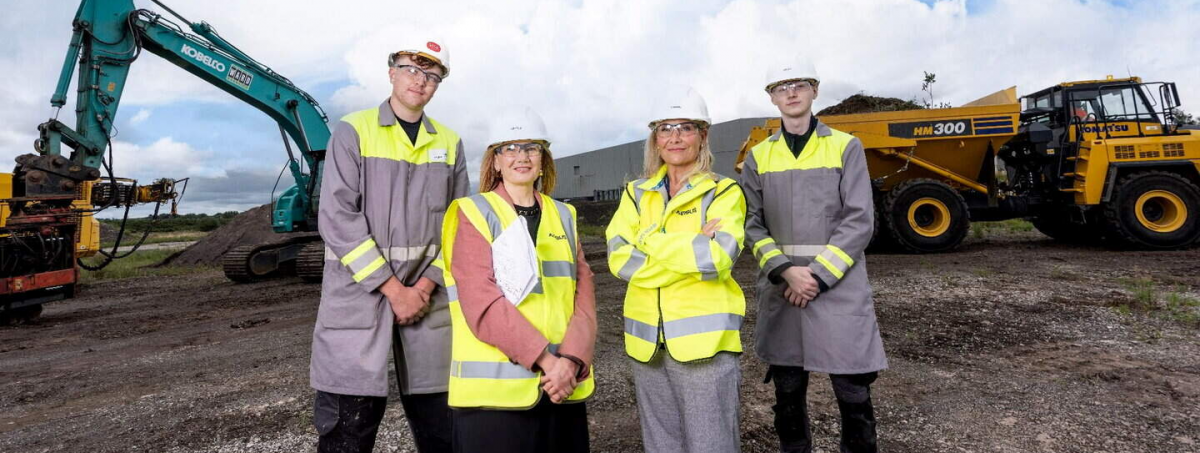
Construction has started on a 6,221 sq m extension to Airbus's Belfast wing facility, a project that gives aerospace suppliers a clear signal of how fast composite wing production is scaling to meet A220 demand, with the site working towards a build rate of 13 aircraft a month by 2028.
The extension is scheduled for completion in the first half of 2028 and will house a third autoclave alongside specialised wing tooling and cranage, expanding the facility's advanced composite manufacturing footprint. Airbus said it will also modernise site infrastructure with a new security gate, high-voltage electrical substations, an office block, an expanded 650-space car park and new IT systems.
Belfast is the exclusive global manufacturing centre for the Airbus A220's wings, a capability rooted in decades of Northern Ireland aerospace heritage.
Airbus, headquartered in Toulouse, France, is a global aerospace manufacturer that took over A220 wing production in Belfast in 2025 as part of its acquisition of certain Spirit AeroSystems assets.
Anthony Rouse, head of Airbus Belfast plant and site, said: "Enhancing our wing facilities is a direct investment in the future of A220 wing production here in Belfast, building the capacity required to meet the growing demand for this aircraft. This commitment is also reflected in our ongoing skills development, including bringing onboard 40 new apprentices who will start in September."
The investment reflects continued consolidation of composite wing manufacturing into Airbus's own hands following the break-up of Spirit AeroSystems between Airbus and Boeing, replacing years of ownership uncertainty at the Belfast site with confirmed, multi-year capital commitment.
Airbus paid $439m in compensation as part of the wider Spirit carve-up, following earlier union warnings that splitting the site's operations risked its economies of scale.
For the sector, the extension and the accompanying apprentice intake signal a shift from crisis management to confirmed capacity expansion at one of Northern Ireland's largest manufacturing employers, stabilising thousands of associated jobs across the site.
The wider signal for the sector is that composite wing capacity, not final assembly, is becoming the binding constraint on narrowbody ramp-ups, prompting airframers to invest directly in owned manufacturing sites rather than relying solely on suppliers.
Source: Aviation Week / Business Eye / The Irish News / FlightGlobal / MarketScreener






.png)