

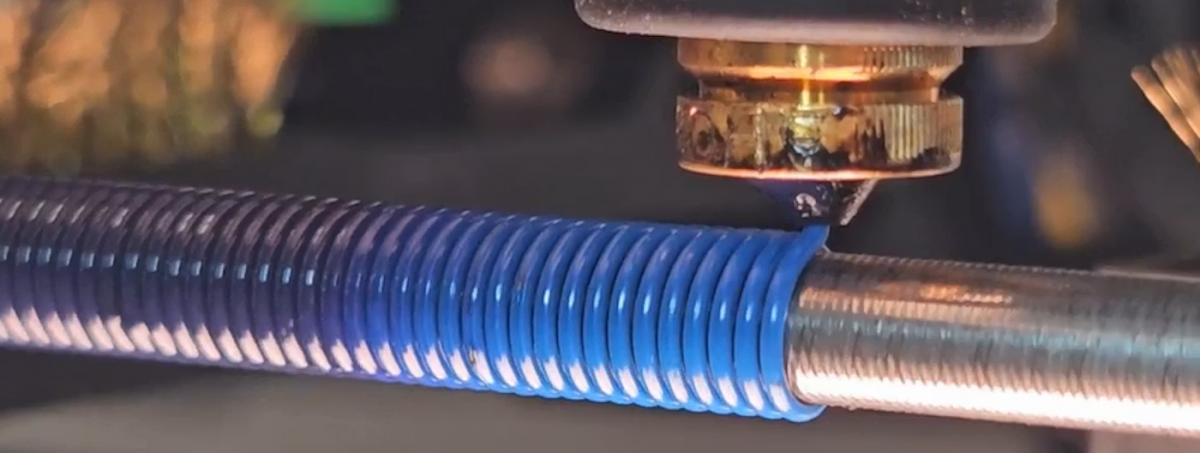
Global connector and sensor company TE Connectivity has introduced a new automated 3D printing process for manufacturing catheter shafts at its PROPELUS Prototype Center in Galway, Ireland, developed by the Advanced Technology Group within the company's Medical business. The development has direct relevance for medical device manufacturers producing minimally invasive catheters, where process complexity and manufacturing cost have historically constrained design flexibility.
As reported by Medical Design & Outsourcing, the new process applies polymer sections directly onto catheter shafts during production, replacing a higher-cost, predominantly manual assembly method commonly used across the industry. Catheters typically require multiple polymer jacket sections with different flexibility characteristics along the length of the device, a construction requirement that has made conventional manufacturing both time-consuming and difficult to scale.
The resulting catheter shafts produced using the 3D printing process retain the same mechanical properties, materials and aesthetics as those made by traditional methods, allowing manufacturers to adopt the technology without compromising device performance or regulatory compliance requirements.
Pat Duane, senior vice president and general manager of the Medical business at TE Connectivity, said: "This work reflects TE's continued focus on advancing manufacturing innovation to help our customers develop increasingly sophisticated minimally invasive medical devices. We believe additive manufacturing technologies have the potential to expand design possibilities, accelerate development and support the future of catheter manufacturing."
The process will allow catheter manufacturers to speed up new device development by enabling TE's engineering teams to iterate designs more quickly. It may also create opportunities for manufacturers to introduce new catheter constructions and device architectures that are impractical to produce using conventional techniques.
Bernard McDermott, medical engineering fellow at TE Connectivity, said: "This process, along with complementary disruptive processes in development, will result in a paradigm shift in catheter manufacturing for our customers. It has the potential to significantly reduce product costs, simplify supply chains and have a positive environmental impact."
TE Connectivity is headquartered in Ireland and listed on the New York Stock Exchange under the ticker TEL. The company employs more than 90,000 people, including 10,000 engineers, across approximately 130 countries, supplying connectivity and sensor solutions to sectors including transportation, energy, automated manufacturing and data centres.
The PROPELUS Prototype Center in Galway serves as a development hub for TE's Medical business, supporting the design and early-stage manufacture of components for minimally invasive medical devices supplied to OEMs globally.






.png)