
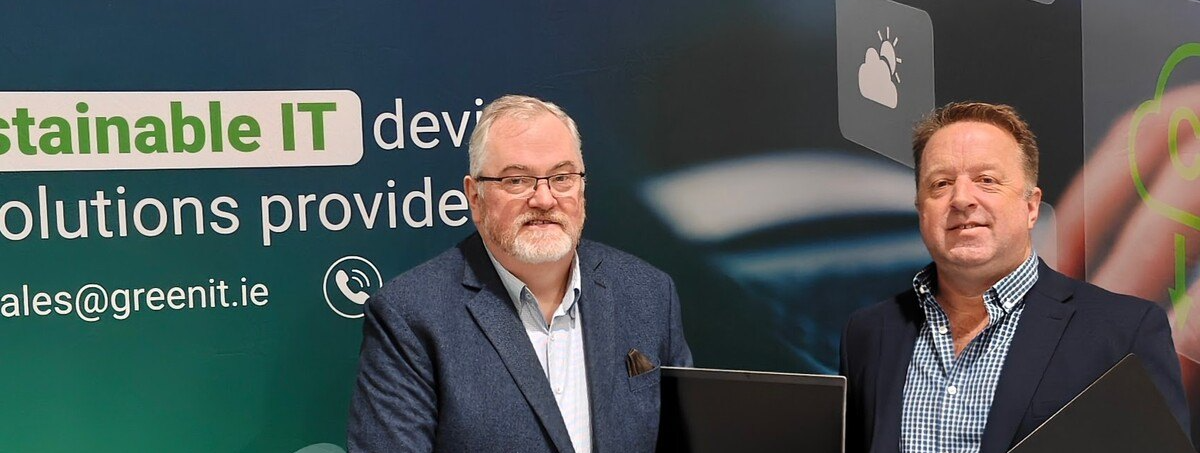
Green IT will open a new 22,000 sq ft refurbishment and remanufacturing facility in Naas, Co Kildare, giving public and private buyers of ICT equipment a larger Irish capacity for repaired and remanufactured devices as an alternative to new manufacture.
Founded in 2013, the company has refurbished and returned more than 500,000 ICT devices to circulation, and the new site will process thousands of computers, laptops, monitors and other devices, with engineers handling component repairs, rebuilds, casing and keyboard restoration and 3D-printed replacement parts.
With remanufacturing partner Circular Computing, Green IT secured a place on the Office of Government Procurement’s Remanufactured Notebook Framework, worth up to €30m over four years, which aims to see around 60,000 remanufactured laptops purchased by public-sector bodies.
The company and Circular Computing say a remanufactured laptop can avoid about 316kg of carbon emissions, save 190,000 litres of water and preserve 1,200kg of natural resources compared with a newly manufactured equivalent; at projected framework volumes, estimated savings reach 19m kg of carbon emissions.
Green IT, trading as PhoenixRM Ltd, is an Irish company headquartered in Naas that employs 24 people and supplies refurbished and remanufactured IT to schools, businesses, charities and public-sector organisations.
Martin Reddy, managing director of Green IT, said the volume of technology moving through the operation is extraordinary and that the work goes well beyond wiping and reselling old computers, adding that the expansion reflects growing demand for affordable technology.
The facility reflects remanufacturing moving from reuse towards industrial-scale production, with specialist engineers rebuilding components and 3D printing parts so devices can be returned to certified standards.
The timing follows the EU Right to Repair rules that came into force in Ireland, which aim to increase access to repair beyond the legal guarantee.
Another refurbisher, Refurbed, has linked demand growth to tightening economic conditions and AI-driven price rises, with environmental concerns playing a consistent but minor role.
For the sector, a framework worth up to €30m shows public procurement becoming an anchor customer for Irish remanufacturers, which can underpin investment in larger sites.
The wider signal for the sector is that circular manufacturing capacity in Ireland is being built around public-sector demand and affordability rather than environmental claims alone.
Source: Silicon Republic / O’Brien PR / Kildare Nationalist






.png)