

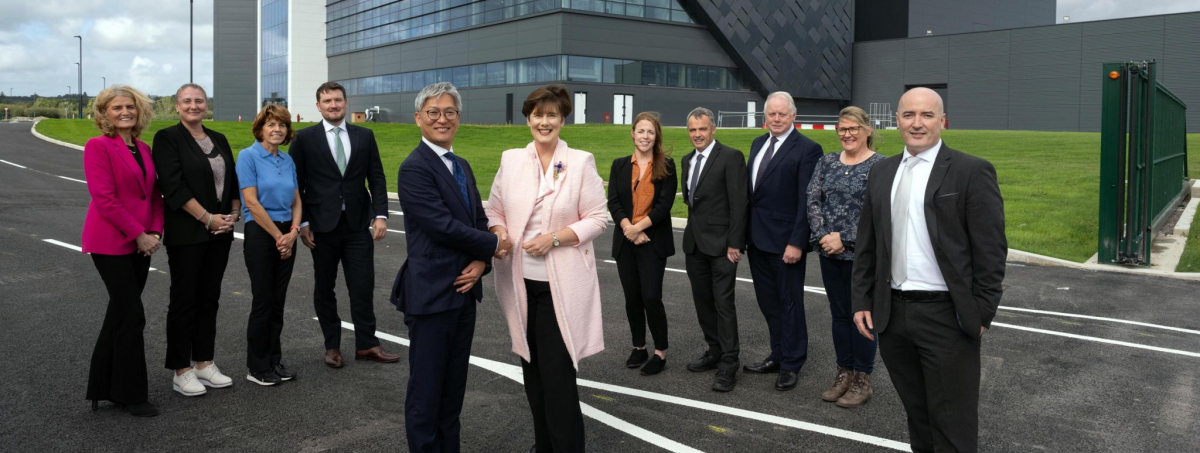
Astellas Pharma is expanding its manufacturing facility in Tralee, Ireland, installing a second aseptic filling line that will double the site's drug-product manufacturing capacity, giving the Japanese biopharmaceutical group a larger domestic base to secure supply of sterile injectable medicines as global demand for aseptic fill-finish capacity continues to outstrip availability.
The expansion at Kerry Technology Park represents the next phase of development at the site and will include the new filling line and associated manufacturing infrastructure, supporting processes including compounding, sterile aseptic filling and lyophilisation.
The project builds on the site's groundbreaking in March 2024 and is expected to create additional highly skilled roles across engineering, production, quality, logistics and support functions by 2029; the investment is supported by the Irish government through IDA Ireland.
Astellas Pharma, headquartered in Tokyo, Japan, develops and manufactures medicines across oncology, immunology, neuroscience and women's health. The Tralee facility, originally announced as a €330m investment in 2023, spans approximately 17,000 sq m on a 45-acre site and focuses on drug-product manufacturing rather than active pharmaceutical ingredient production.
The expansion reflects a structural shortage in global aseptic fill-finish capacity, with utilisation rates exceeding 85 per cent in 2024 and scheduling backlogs of 18 to 24 months across contract manufacturers, prompting large pharma companies to expand owned capacity rather than compete for scarce outsourced slots amid rising demand for biologics.
The global sterile injectables CDMO market is projected to grow from $17.13bn in 2026 to $26.92bn by 2031, a 9.47 per cent compound annual rate, driven by expanding biologics pipelines and limited in-house aseptic capacity among mid-sized pharma companies.
For the sector, Astellas choosing to expand an existing Irish site rather than build a new facility elsewhere reinforces Ireland's role as a preferred location for follow-on pharma manufacturing investment once initial capacity has proven out.
The wider signal for the sector is that phased capacity expansion, doubling an existing line rather than commissioning an entirely new facility, is becoming the preferred model for global pharma manufacturers scaling aseptic capacity, reducing both regulatory and commissioning risk.
Source: Cleanroom Technology / GlobeNewswire






.png)